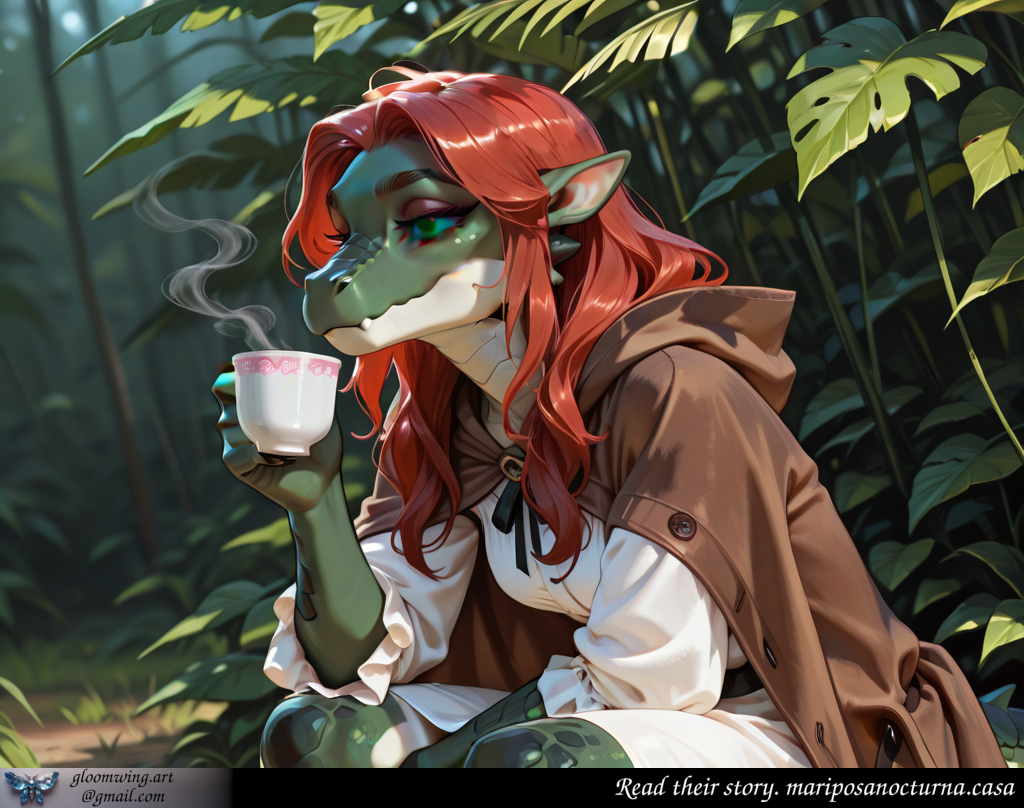
Today I woke up a little later than usual – well, the previous day was quite exhausting. After waking up, I stayed in bed for a while, digesting yesterday's experiences. When I finally got up and walked outside my tent, I saw Silvana at the edge of the forest. She had prepared a picnic for me for breakfast! Of course, I was delighted to receive real fresh bread, coffee, tomatoes, and other things I wouldn't mind at home.
Of course, I didn't hesitate to ask a few questions today – I started with what came to mind (I'd been thinking about it, but of course, I hadn't prepared a list) – namely: where did all this come from? It's quite a long way to the nearest bastion of civilization, she replied, perhaps slightly offended that this is a bastion of civilization. After a short pause, she explained that it was all because they'd been living here for a long time and had managed to organize their existence: they have a field, a kitchen with a bread oven, etc. There are also chickens here. They also had a cow, but it died of old age when Silvana was still a child.
Again, my surprise must have been evident on my face, because she said she could show me all this right away. Of course, I gladly accepted the invitation – after all, aside from some faux documentation of plants and animals (I have to remember to do that, though), I didn't have any particularly specific plans.
As we were getting ready for our tour, while I was packing, I remembered yesterday's incident with the gun, so I asked about it.
It turns out Silvana had been watching me for a few days now. She'd noticed our group now, and earlier, when we were passing through this area to the archaeological site. It's not like she has any superpowers – yes, she has a fairly good sense of smell and hearing, but it's more a matter of living in the wilderness, far from civilization, which has heightened her senses. It turns out that every time our group passed through this area, the forest sounded... different, in a way that could be compared to the change of tone with the seasons. I admitted that it didn't make much difference to me, so we moved on.
When she saw me at the waterfall, she realized she needed to be a little more cautious – no one had ever been near the falls without a clear invitation. I asked her what she meant by an invitation, and she said she meant the medallion, but she'd explain later. She observed our group as we returned and when we reappeared. Our role as archaeologists seemed to fit our behavior, but you can never be too careful. On the very first night, she snuck into my tent and made sure my gun wouldn't fire. She also saw my books and a few other things, so she knew what language I spoke. It turns out she's fluent in several, if not a dozen, languages, most of which she'd learned from letters and textbooks.
Before we gathered, she asked if she could see my things. She was most interested in literature: unfortunately, I had little to share – I didn't bring any newspapers, but I did have a few books (I prepared myself for the need to kill time). I had:
- The Time Machine – a science fiction novel by Herbert George Wells,
- King Solomon's Mines by H. Rider Haggard – it tells of an expedition through an unexplored region of Africa by a group of adventurers led by Allan Quatermain, searching for the missing brother of one of the party,
- Prester John, an adventure novel by the Scottish author John Buchan. It tells the story of the young Scotsman David Crawfurd and his adventures in South Africa, where a native uprising under the charismatic black minister John Laputa is linked to the medieval legend of Prester John.
- Morning Star is a historical novel with fantasy elements by H. Rider Haggard, set in Ancient Egypt, some time after the expulsion of the Hyksos from Egypt (around 1500–1200 BCE).
Of these four books, she wasn't interested in the first two because she'd already read them, but she really wanted to borrow the last two. I gave them to her immediately, and off we went.